|
|
























HANDCARTZ.COM
Page 6
HAND CART SERIAL & OWNER LIST
Page 6
MACHINE GUNNERS MANUAL
By Thomas j. Heavey. 1936
Page 7
By Thomas j. Heavey. 1936
Page 7
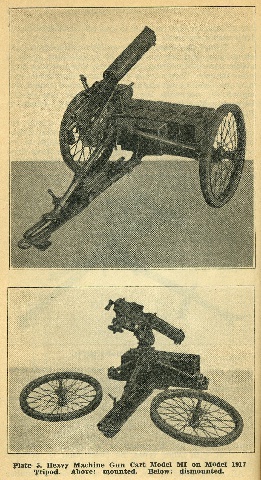
6. Methods of Transportation The heavy machine gun is transported in the Infantry, on the Machine Gun Cart, Model
M1, as illustrated in plate 5. This cart may be either animal drwn, being attached by lunette to the ammunition cart, or
pulled by man power. Ammuntion and water are carried in chests, both on the cart proper, and the limber. A distinctive
feature of the new type cart is the incorparation of a "T" base in the cart, which when the wheels are removed, may be
used as an additional stable base for the mounted gun.
Heavy machine guns in the cavalry are transported on pack horses, the gun, tripod, and the ammunition, being secured to the standard Phillips cavalry pack saddle by suitable hangers.
Heavy machine guns in the cavalry are transported on pack horses, the gun, tripod, and the ammunition, being secured to the standard Phillips cavalry pack saddle by suitable hangers.
MACHINE GUNNER POCKET MANUAL.
THE INFANTRY JOURNAL. 1931
Page 80-81
THE INFANTRY JOURNAL. 1931
Page 80-81
The technique of antiaircraft fire for machine guns is a continuing study. many types of equipment have been tested;
several devices which give promise of suitability are under test as this volume goes to press.
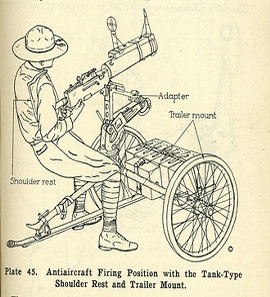
This chapter is based on the infantry trailer mount (plate 45), which has been tested and adopted: the Boyd-Greene antiaircraft sight (plate 46), which is now on service test, and tracer ammunition, for use in the adjustment of fire: and the T4E1 adapter (plate 45), which more nearly approaches the requirements of such a device than any other of the several whaich have been tested.
This chapter is based on the infantry trailer mount (plate 45), which has been tested and adopted: the Boyd-Greene antiaircraft sight (plate 46), which is now on service test, and tracer ammunition, for use in the adjustment of fire: and the T4E1 adapter (plate 45), which more nearly approaches the requirements of such a device than any other of the several whaich have been tested.
MACHINE GUNNER POCKET MANUAL.
THE INFANTRY JOURNAL. 1931
Page 89-90
THE INFANTRY JOURNAL. 1931
Page 89-90
Improvised Mounts
Pending the issue of the infantry trailer mount in sufficient numbers to equip all machine gun companies, two
improvised mountings for the gun and tripod are suggested. Both methods require no alteration of present
ammunition carts.
In the first method the front trail legs are opened out, with the front legs in as nearly a vertical position as they can be placed. The front legs are than placed on the two rear corners of the ammunition rack, with the trail leg running to the front of the cart. All tripod legs are than lashed to the cart body, the traversing clamp is loosened, and the elevating arc clamp is loosened slightly so that changes in elevation may be made by placing pressure on the grip.
In the second method all ammunition boxes are placed in the rack, with the bevelled edges to the inside. The front legs of the tripod are folde back against the trail leg and all three legs are buckled together. The tripod is placed on the cart in the center of the rack, with the cradle to the rear, and the tripod legs are lashed to the longitudinal piece which runs the length of the ammunition rack. The transversing clamp and the elevating arc clamp are loosened, as in the first method. this mounting is less stable than the method described above, but gives higher angle of fire.
Pending the issue of the infantry trailer mount in sufficient numbers to equip all machine gun companies, two improvised mountings for the gun and tripod are suggested. Both methods require no alteration of present ammunition carts. In the first method the front trail legs are opened out, with the front legs in as nearly a vertical position as they can be placed. The front legs are than placed on the two rear corners of the ammunition rack, with the trail leg running to the front of the cart. All tripod legs are than lashed to the cart body, the traversing clamp is loosened, and the elevating arc clamp is loosened slightly so that changes in elevation may be made by placing pressure on the grip. In the second method all ammunition boxes are placed in the rack, with the bevelled edges to the inside. The front legs of the tripod are folde back against the trail leg and all three legs are buckled together. The tripod is placed on the cart in the center of the rack, with the cradle to the rear, and the tripod legs are lashed to the longitudinal piece which runs the length of the ammunition rack. The transversing clamp and the elevating arc clamp are loosened, as in the first method. this mounting is less stable than the method described above, but gives higher angle of fire.
MACHINE GUNNER POCKET MANUAL.
THE INFANTRY JOURNAL. 1931
Page 98
THE INFANTRY JOURNAL. 1931
Page 98
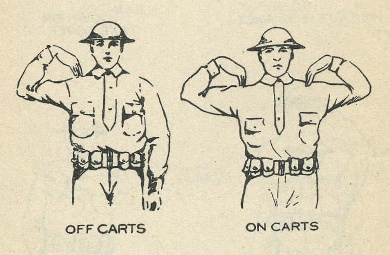
Off carts
Face the unit for which the signal is intended: raise one elbow laterally to
the height of the shoulder and touch the shoulder with the fingers
On carts
Face the unit for which the signal is intended: raise both elbows laterally to the height of the shoulders and touch the shoulders with the fingers.
Around Cart
Extend the arm and the hand towad unit(s) concerned, hand pointing down: describe large horizontal circles with the hand by flexing the arm at the elbow and shoulder.
MACHINE GUNNER POCKET MANUAL.
THE INFANTRY JOURNAL. 1931
Page 152
THE INFANTRY JOURNAL. 1931
Page 152
Transportation
The handling of the carts will usually be very difficult. They should be kept close to the gun positions even if there is
some danger of their loss, because a very rapid withdrawl when the mission has been accomplished may save the
guns from destruction.
MACHINE GUNNER POCKET MANUAL.
THE INFANTRY JOURNAL. 1931
Page 153
THE INFANTRY JOURNAL. 1931
Page 153
Supply
Adequate and uninterrupted supply of ammunition, water, oil, and spare parts is essential to the successful
employment of machine guns in conbat. These supplies are brought as far forward as possible on the combat
wagons, and as much farther forward as is safe on carts. In action the carts may sometimes be left under cover close
to the gun position, while animals are taken back a safe distance. The carts then serve as an ammunition reserve and,
if a change of position is ordered, can be loaded and ready to move off as soon as the animals are brought up. The
difficult task of concealing the transportation is thus made easier.
In mountain warfare and in jungles, resort must be made to pack transport and man-handling. The use of pack animals throws a great strain on men and animals. Many more animals are required to transport the equipment normall drawn by the two mules of each squad. Pack animals are difficult to manage under fire and should not be used unless the use of carts is impossible.
In mountain warfare and in jungles, resort must be made to pack transport and man-handling. The use of pack animals throws a great strain on men and animals. Many more animals are required to transport the equipment normall drawn by the two mules of each squad. Pack animals are difficult to manage under fire and should not be used unless the use of carts is impossible.
MACHINE GUNNER POCKET MANUAL.
THE INFANTRY JOURNAL. 1931
Page 153
THE INFANTRY JOURNAL. 1931
Page 153
Ammunition Distributing Points
Battalion. The combat train brings ammunition, water, oil, and spare parts to the battalion ammunition distribution
point, where they are unloaded from supply wagons directly to the machine gun carts as required. The combat train
carries 2500 rounds of ammunition for each machine gun. Companies equipped with the M1917 carts carry 4250
rounds for each gun. Units equiped with the wheeled machine gun mount and the new infantry cart carry 8,000 rounds
per gun.